by Britt Bustos
September 22, 2026
Exhibit G by Fady Joudah; Milkweed Editions; 208 pages; $30.00.
There's a particular kind of dread that comes from opening your phone and knowing what's waiting in the feed. Fady Joudah's Exhibit G lives inside that dread, but refuses to look away from it, or from us, the readers scrolling past. This is Joudah's first book to move beyond poetry into essay and photography; this mixing of forms is a stylistic choice rather than a necessity, as if no single genre could hold what he's trying to say. Joudah is a Palestinian-American physician writing from inside the country funding the destruction of his own family, but he doesn't ask us to feel sorry for Gaza. Instead, the author asks us to reckon with how we're already looking at the genocidal tragedy, and similarly, what that looking costs.
The title poem, "Exhibit G: Surviving Image," sets the author's terms early, reading almost like a deposition of short, unadorned paragraphs stacked one after another. Readers learn of a brother killed, a sister-in-law killed, three children killed, a fourth who survives and later has a baby of her own. Joudah doesn't let you sit in that grief for long before he turns the poem's attention to how grief travels:
The world that produces horror circulates its horror in images. Self-rebuke
as a form of self-congratulation, war crime as humblebrag while bloodlust is
inevitable.
If it's an uncomfortable thing to read while holding a phone in one's hand, this reviewer thinks that's part of the point Joudah is making -- how can one be so removed from devastation and genocide yet still witness its every horror? By the poem's end, the author asks the same devastating question twice, flipping its terms:
"What is enough childhood for a people to stay alive? What image of childhood is enough for a people to stay alive?"
I feel both halves of that question land differently and neither one necessarily lets me off the hook from my complacency.
Joudah shifts into essay with "Symphony in G Major," the book's longest sustained piece. The author cuts between the assassination of a journalist in Gaza, one he'd predicted himself days before it happened, and a scene at a tapas restaurant where a friend is workshopping a novel about his own Gazan childhood. The gut-punch comes in a single, almost throwaway line: the friend's literary agent, reading along, says she likes it so far but hopes it'll "soon get to the genocide." Here is Joudah, describing the market's appetite for Palestinian suffering, implicating the very form he's writing in (and by extension anyone reading it), for the same reasons that agent is reading that manuscript. The essay keeps circling that discomfort without resolving it, landing eventually on a definition of hope that has nothing comforting in it: "Hope, a Sisyphus. A boulder for a slope."
The rest of the collection keeps finding new angles into the same heart wound. "Citizen Science" and its companion piece, "Addendum to Citizen Science," turn to backyard birdwatching, of all things, as a way into the book's larger questions about care and extinction. There's something almost funny, in a bleak way, about the line:
"A bird isn't solidly middle class,"
before the poem pivots hard into a much heavier realization:
"The birds won't know we were ever here."
After reading these two poems back-to-back it hit me that Joudah has been building toward that angle of erasure the whole time.
That same question of who's watching and importantly, who has stopped watching, is what these birds are circling. Not so long ago, there was a stretch of time when the whole world was pinned to the same screen for the same reason: the pandemic put an atrocity in front of everyone at once, whether they wanted to look or not, and for a while the shared and forced attention we all gave felt like it counted for something, maybe a search for a greater connection in an environment where community was limited to these parameters. Reading "Citizen Science" against that memory, Joudah's birds look like a quiet rebuke. We haven't looked away from our screens since; we've just now stopped looking at the same thing. The feed simply multiplied, splintering along our unintentional preferences and convenient biases. In that multiplying, the platforms and algorithms decided what surfaces would take over the job that human attention used to do on its own. The world didn't grow numb to genocide so much as it grew organized in its erasure, sorted by design rather than worn down by repetition. We've been scattered across a hundred private feeds instead of one shared one, and ignoring Gaza now feels more like a default setting the algorithm intended.
The shorter lyric poems scattered throughout, "Horse on a Loop," "Barzakh," "After the Genocide," work almost like a short breath between the longer, denser pieces - they're smaller and quieter but speak volumes within the comparisons of his longer lyric essays. "After the genocide, the genocide," he writes, using repetition to refuse his own poem any kind of ending and nodding to the maddeningly cyclic nature of tragedy upon tragedy. Scroll far enough through any feed and you'll watch one atrocity get buried under the next, each fresh headline pushing yesterday's further out of view until it disappears completely. We are left with a desensitization from seeing too much while simultaneously being shown too little, filtered down to whatever the feed decided was worth our attention. It isn't hard to imagine Gaza meeting that same fate had this book not insisted on staying with it. By the time readers finish the written components and look back at the book's photographs, grainy and unposed, they feel like more evidence stacked onto the case that never should have needed making in the first place.
Exhibit G does not try to wrap anything up neatly and instead offers Joudah's insistence on returning, again and again, to what's specific and named rather than what's abstract.
"I must return to my cousins," he writes near the book's end. "I must return you to my cousins."
For an author and physician who himself left to study and stayed to practice medicine an ocean away, that return happens clearly on the page, through cousins summoned back into being one line at a time because no permit or border crossing will get him any closer. This homecoming, this reparation is built entirely out of language through its own form of grief and loss: the nearest Joudah can get to holding his family right now is writing them back into existence for strangers to read. To bring visibility to a people long buried under the rubble of imperial evils and showcase the beauty, grace, and continually needed education and advocacy of one of humankind’s longest-standing civilizations of dreamers, makers, cousins, cooks, vendors, lovers, friends, and children who will keep returning in the same way the author does, until someone finally has to look.
After nearly two hundred pages of grief circulated, questioned, honed upon, researched, reflected, and finally refused, that return to the telling of the story, of the glimmering spectacle of hope and awareness and the faint possibility of something like this never happening again, is the image that survives. What the looking costs, in the end, is the belief that looking was ever enough on its own: our sanity if we keep scrolling, our conscience if we look away, and any faith we had left that witness alone could add up to justice.
__________________________________________________________________________________________________________________________________________________________________________
__________________________________________________________________________________________________________________________________________________________________________
__________________________________________________________________________________________________________________________________________________________________________
"What Image Is Enough": Collective Grief, Circulation, and Survival in Fady Joudah's Exhibit G.
POETRY REVIEW

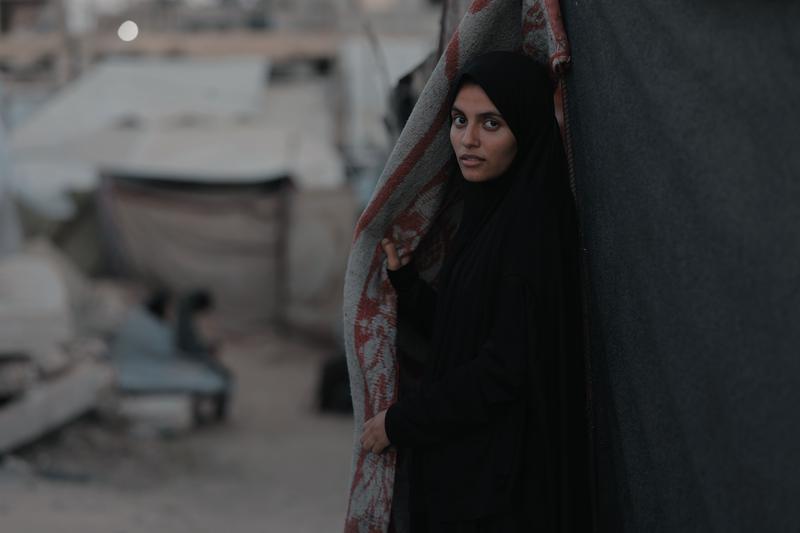
Image by Hosny Salah from Pexels
Britt Bustos (she/they) is a poet, editor, writer, educator, and musician taking up space in Houston, TX. Their works appear or are forthcoming in new words {press}, Heavy Feather Review, table//FEAST Literary Magazine, The WAC Clearinghouse, McNeese Review, Atticus Review, and elsewhere. She serves as an associate poetry editor for West Trade Review and is associate editor of The Texas Review. They received their MFA and MA from Sam Houston State University, where they currently teach English and Creative Writing. Find them @brittbustos.
__________________________________________________________________________________________________________________________________________________________________________
© 2025 Iron Oak Editions
__________________________________________________________________________________________________________________________________________________________________________
© 2026 Iron Oak Editions




Stay Connected to Our Literary Community. Subscribe to Our Substack Roots & Words