
Claire Jussel Speaks with Geneva Toland
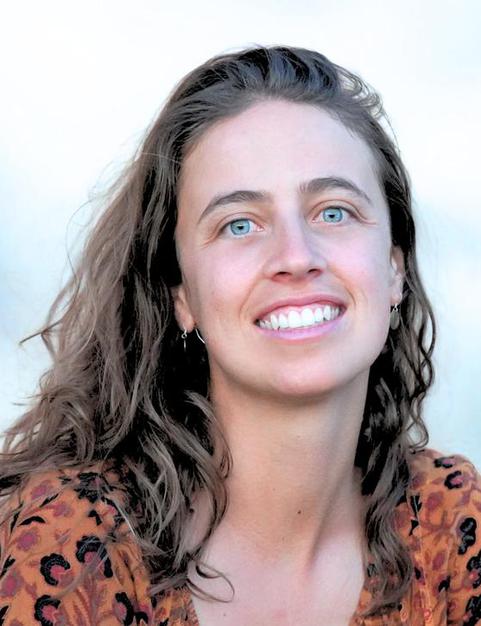
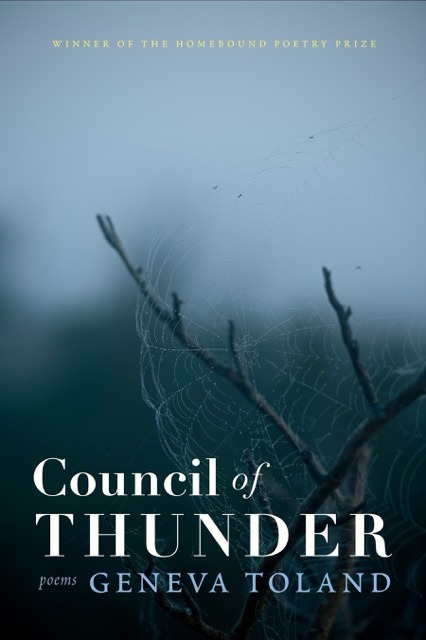
Geneva Toland (she/her) is a writer, educator, songleader, and naturalist living in the juniper-piñon foothills of the La Plata mountains, homelands of the Ute, Diné and Puebloan peoples. Her debut poetry collection, Council of Thunder, is the winner of the 2025 Homebound Poetry Prize. Her work has appeared in Southern Humanities Review, Camas, Four Corners Voices, Reckoning, and humana obscura, among others. She is a poetry editor at Terrain.org and holds an MFA in Poetry from the Institute of American Indian Arts. She devotes her time to community regeneration through teaching, creative writing, ancestral reclamation, singing in circle, growing food & flowers, and playing with kids in the woods. Her debut poetry collection, Council of Thunder, is available for purchase from Wayfarer Books. You can also find her poetry in the Ecobloomscapes anthology from Iron Oak Editions.
CJ: Your debut poetry collection, Council of Thunder, begins with a poem titled “Once Upon a Time.” Could you speak to this choice and implications of starting a collection of poetry with this phrase?
GT: I'm fascinated with the long history of stories in humanity's lifetime, and their importance in human culture. That phrase “once upon a time” is so culturally important for Western, European culture, but was also so important for me as a child. There’s something that happens when someone says “once upon a time.” It's like opening of a door, or a ritual invocation to shift into a different reality, a different moment, a different way of being where things are possible that weren't possible before. As this poem came to be, I was also thinking about the myth of the self. I was reading Bill Plotkin’s work at the Animas Valley Institute on the stages of human development and, specifically, the stage in which you claim your gifts and who you are in the world. One practice Plotkin offers is to tell a myth or story of who you are, and put language to your soul "self" as a way of discovering and solidifying that identity. So while writing this poem, I was asking, “What would be the myth of self for this speaker?” Opening with "once upon a time" allows this myth to be languaged, and this became a core poem for the speaker, but also for me as a person and artist naming what I was setting out to do in this work. At one point while assembling the collection, I considered putting it later in the book, but it became clear that this was the invocation and ritual opening for this book. This is the moment where the speaker gets to emerge into view and tell her story. It also feels joyful to start that way, to invoke a childhood magic and sit the audience down for a story.
CJ: Right from the jump in that first poem, "Council of Thunder" is well populated with other-than-human beings. These figures are often named directly even when human figures might be poetically concealed or less directly named. How does this specific naming inform your poems?
GT: The more-than-human world became a place of solace for me in my twenties, as I came into adulthood and reckoning with what I've inherited. So many different species have different ways of being that helped take me out of my human smallness. For example, sitting with a juniper tree–who can easily be over two hundred years old here in Colorado–I could feel a distinct, quiet, old presence. It felt so helpful to have each species and their individual wisdom and ways of being help me understand how I can choose to be in the world. That's obviously not a new way of relating to the natural world. That is a very old and indigenous way of being with the Earth and with place. And so it felt more like a remembering, a coming home to interconnection.
In some ways, this practice of remembering was also a disruption of the inherited story that humans are the greatest species and everyone else is below us. That story that we are the greatest, most advanced species on this planet was not going to help me get through the reckonings that I had to get through in my 20s. What did help me was the older, deeper story that we are a young species, and we have a lot to learn from our more-than-human kin. So that was the story I wanted to stumble my way back into. And so the poems that are from those specific beings were my moments of stumbling, of saying, “Okay, I actually don't want to be the speaker anymore, I feel like I need somebody else to guide this poem, and this book, and my life.” These specific names arrived because I specifically sat with those beings and thought about what they would say to me if they could speak. I was always deeply humbled by what came through–like I definitely did not come up with that alone! That’s some other, deeper magic that poetry lets us have access to.
CJ: While this collection pays particular attention to place, it also pays attention to time, particularly the shifting of seasons. What role does time and seasonality play within the collection and in your creative process?
GT: This book came together in a very surprising way. I did not plan to write it. I was actually writing poems towards what I thought would be a different book. Then, when I finally looked at all of my poems together, I realized that there were two different speakers, or even more than two speakers, and they were very distinct. Along the way, one of my mentors, the brilliant poet Anaïs Duplan asked “What is the universe of your book?” and I realized that each speaker lived inside their own universe. In separating them out, I found the universe that would become Council of Thunder.
The speaker for this book was one who was growing up. Once I understood who she was, and who she was becoming, then the "time" of the book started to make sense. I realized, “Oh, she's on a journey, she's aging, seasons have passed.” The presence of the seasons acknowledges that growth takes time. We don’t grow up in a season or even a year; it takes a lot of time to complete a journey. The passing of each season marks this for the speaker, like a spiral returning to the same place but never at the same exact point again, and never as the same person.
CJ: Continuing with that thought about the arc of this book–this collection contains three named parts: Sleep-Walk, Thunder-Wake, and Morning Bird. As you were compiling this body of work, how did you go about assembling these sections within the arc of the collection?
GT: As I began to sort the poems in this collection, I found three different energies from the speaker of the poems. In one energy the speaker was walking through her life, looking at it, but not doing anything about it. It was a kind of an accounting of all the places something felt off. I think of this set of poems as the heartbreak set– it’s a grief fugue. I went through a couple powerful heartbreaks in my twenties alongside some health difficulties and body trauma that put this speaker into a fugue state in which she doesn’t recognize her life anymore. So those poems feel like a sleepwalk.
In the next group of poems, the speaker is awake to reality and pain and no longer dissociating, and learns she prefers this from sleepwalking. There’s a power in the choice to be awake to the world, but this awakeness also rocks her like thunder. Because the speaker allows herself to be shaken by the world, there is a release in the third section. In this section, the speaker gets to move out of the storm–the clouds have cleared, the sun is rising, the birds are singing. Not everything is perfect, but there is a sense that she’s back in her life again. She has control over the narrative that she tells herself. This third section feels like a reclamation of joy and pleasure and sovereignty and belonging in the ecological web, as fucked up as it might be. Whatever state the world is in, that is the speaker’s home, that is our home. And in that acceptance, there is relief. As Spider says in the last poem, “Eventually, you do need to put the past behind you.” Eventually you have to let the past be what it is and move on to the new morning. This arc only emerged after examining and rearranging the poems in this collection. These different energies of the speaker told me a story I didn’t fully know I was telling from the outset.
CJ: Many of the poems in this collection reckon with the tension and experience of loving and hurting in relation to the world that the speaker lives within. In the poem “Baptism in the Anthropocene,” you write “this is a way to the world my love, this is the way to the faulting.” How do you understand the connections between faulting and healing, loving and making mistakes in the relationships that you present across this text?
GT: This poem still breaks my heart, that that’s where I end it. In earlier drafts, it ended on a different note with something closer to “I won’t let you live this warming alone.” That original ending claims companionship through chaos, which is a beautiful sentiment, and something other poems in the collection touch on. But this poem ultimately isn’t about that. The original ending felt like seeking a point of resolution. But this poem did not want resolution. It wanted to sit in the "fault line" and be with the mess and chaos of what is. "This is the way to the world," the poem echoes, guiding the speaker to the actual world—the world of heartbreak, violence, wildfire and a future of great uncertainty. A world of fault and mistakes, harm and regret. The poem beckons the speaker into this fault line and asks her to sit in the discomfort of it. To make a home there. And what emerges from that, like any place touched by fire, is, of course, transformation.
CJ: How does the relationship to mistakes and also seeking connection while acknowledging fault echo in your process and writing and creating?
GT: So much of this book feels like a reaching towards acceptance, towards surrender. There was an earlier poem that didn't make its way into this book, but was necessary for me to start thinking about the difference between surrender and defeat. We often mix up being in defeat and being in surrender, especially in Western culture. But they actually have very different energies. It's a difference between letting go with an energy of “I have failed” or letting go with an energy of “I cannot control everything, some things are the way they are, and there's nothing I can do about it, and that’s not a reflection of who I am as a person.” Throughout Council of Thunder, the speaker matures as she continually accepts the harm, the violence, the people who've made mistakes that have harmed her, as well as her own mistakes that have harmed others, her complicity in ecological collapse, her complicity in her inheritances, and all that she doesn’t know. In the first half of the book, there is a lack of surrender, and more of a fighting of what is. And in the middle of the book, there’s a realization that fighting isn't really getting her anywhere—fighting against her mistakes, fighting against the mistakes that others made, fighting against the messes we've collectively made, isn't helping her as a human. This leads to a turning out to the more-than-human world to ask “if we are here, then what now?" There is a surrender to not-knowing, that is not a defeat, but an allowance to be changed.
Writing these poems grew me up as a person and as a writer. Eventually, you realize there are only so many poems you can write about resistance; eventually there comes a need for counterbalance where you need to write about acceptance.
CJ: There are two poem series in this book. The first, a series of nine poems entitled “dear my old love” are spread out across each section. How did those poems come to be distributed and serve as a pulse throughout the text?
GT: I really was certain for so long that these "dear my old love" poems were going to live forever in a box underneath my bed. They are so personal to the speaker and therefore closer to me than a lot of other poems. These poems are moments where the speaker gets to kind of tell it straight–to speak directly to a heartbreak, or a pain point. Not all the loves are the same person, but are moreso a gesture toward all the loves in her life that have let her down or have hurt her or have not turned out the way that she thought they were going to. The pain in these poems is a more personal pain than ecological pain in some ways. But they actually aren’t so different.
I realized learning to be a human in relationships and to move through the pain of love is very, very similar to, and happened at the same time as, learning to be a human in love with the natural world. In my twenties, I found out that to really love a place at this moment in human time is a direct pathway to grief. You cannot be fully awake and in touch with the planet now and not be devastated by what’s happening. The more I intentionally focused on deepening my love and relationship with the natural world, the more I felt utterly heartbroken in a way that felt exactly the same as when a lover and I didn't work out.
At first I had all the “dear my old love” poems clumped in the middle because I wanted there to be an extra emotional moment for the speaker, but they didn't want to be next to each other. In these poems, the speaker is alone in a room, just writing in her notebook, feeling that way you can only feel when you're alone in a room writing to someone you can't talk to anymore. There is a loneliness in them. They represent those moments where you go home and think about that person you really wish you could stop thinking about. So they needed to be spaced apart, as a sort of pause-moment where the speaker just gets to be with herself. There’s a journey within these poems too: over time, the love changes, and the acceptance changes them.
CJ: The other series of poems arrive primarily at the very middle of the book, and are then echoed in the penultimate poem, and deliver counsel from various other-than-human teachers. How did you go about selecting or arriving at the particular figures to sit in council with?
GT: These poems are opposite to the solitary “dear my old love” poems. In this series, I play with the word “council” and its different meaning with different spellings. How it is spelled in these titles, “council,” means to sit in circle. Many Native American and Indigenous cultures, as well as European people in my own ancestry, practice council as a way to make decisions. I’ve followed Joanna Macy's "Work that Reconnects" for awhile, and in this work there is a practice where you sit in a circle in a room of people and each person speaks from the perspective of a different species in the ecological web. When these “Council” poems arose, I was engaging in a similar practice while on a residency in the place I call home in southwest Colorado, except with the actual beings themselves. I intentionally went out every day and wrote what came through by sitting with a different species and writing whatever came through in conversation with them.
For example, I’d sit with jackrabbit tracks and wonder, okay “what does this being’s world look like?”I would ask them for counsel, or advice and guidance. And I would write down what came through as an answer. I had a few other poems in this series that didn’t make it into the book, but I ultimately wanted to represent the range of the web of beings that are my teachers here. We have a lot of thunderstorms here in the spring and summer, so I had to have a thunder poem. In a similar way, the series did not feel complete without juniper, coyote, and jackrabbit, which are also keystone species here.
CJ: I’m always so intrigued how authors come to a title for the collection. How did Council of Thunder emerge as the title for this body of work?
GT: I love telling this story because I get to talk about my dear friend, Eleanore Tisch, who is a brilliant poet, amazing person, and one of my favorite humans on this planet. I'm so grateful for my literary friends, and I've been so lucky to have so many different teachers and mentors read my book and see the things I can't see. Eleanore read an early draft of this book when it was called something like “nurtured by salt” or “salt wound,” referring to one of the last lines of the collection: "a wound nurtured by salt." I love that image of ocean water healing our wounds with salt water, which stings and involves pain, as most healing does. But Eleanore identified that the title wasn’t quite right. She said, “The speaker in this book is not messing around. She’s taking you by the shoulders and shaking you, and the title needs to reflect that.” We both agreed it needed something with the image of thunder, which already had a strong presence in the book. So we arrived at Council of Thunder together–it was collaboratively birthed, which feels so right that it wasn’t just created by me.
People often think poems are created by one person. There is not a single poem in this book that was just created by me. All of them have been touched by so many different people. We make each other better. And I think that's what this book is saying. The more interconnected we are, the stronger we are.
CJ: Both in this sequence of council poems and across the book, there are a number of teachers and lessons imparted about how to belong and come into one’s own in relation to the wider world. How does the act of creating and writing around these figures, these questions, help articulate and understand this counsel?
GT: I started writing this collection at a moment of deep heartbreak. I had just emerged from an intensive wilderness program where I was spending ninety percent of my time in the woods, practicing relating to the earth as a living thing and in a community that was really interested in interconnection. When that container ended, I was spit back into normal life. I was also going through a significant separation with a partner and navigating serious health challenges. So this collection started with a moment of “oh my god, is this the world I have to live in for the rest of my life?”
At that time I had no answers. Writing these poems helped me write my way into an answer. It’s why I think writing saves lives. If you write towards something, writing changes it. That’s the power of art, especially the power of writing. There’s something spell-like that happens if you start writing about something head-on. By the end of the poem, it’s not the same thing anymore. Those poems demanded that I move on from my griefs and resistances, to acknowledge that yes, this is where we are, yes this sucks, AND there is so much beauty around me that can be accessed at any moment. These poems helped me access this beauty and claim grief as a teacher.
CJ: As you say in the acknowledgements, Council of Thunder invites us to seek "mutual thriving" in our world. The poems bring us many lessons on how to engage in this seeking. In advance of or in companion to reading your book, what would you advise to our readers to take a first first step towards seeking their own counsel from and with our world around us?
GT: First of all, it’s worth remembering that everything–your home, the humans around you, your car–are all part of the web. I’d also invite us towards recognizing the individual beings you encounter as neighbors. The tree outside your home is not just a tree, it’s *that* specific tree outside your home. We often are able to do this with pets, or even house plants, where we can recognize an individual, but lose that ability when we look a little wider. So my invitation is to take that level of recognition outside your door. If you see a bird, it’s not just a bird, it’s a type of bird, and an individual of that type of bird. That chickadee is not just a chickadee, it’s a chickadee who lives in the juniper outside of your house. That is how we start to build a relationship. When we see an individual, we are better able to listen and ask “what do you need? What’s going on with you?” The deeper relationship we have with the places we live, even just right outside our front door, our watersheds, our planet, can be such a joyful practice. And it’s all connected. The squirrel in your backyard is connected to the squirrel in my backyard. It is one web. If you start by acknowledging one being, you touch the whole web. That’s the magic of the world.
__________________________________________________________________________________________________________________________________________________________________________
__________________________________________________________________________________________________________________________________________________________________________
__________________________________________________________________________________________________________________________________________________________________________

October 27, 2026
Claire Jussel is a poet and artist from Boise, Idaho. She earned an MFA in Creative Writing & Environment from Iowa State University and serves as an associate poetry editor for West Trade Review. Her previous places of work and fascination include bookselling at Wild Rumpus in Minneapolis, park-rangering in Wyoming, and occasional lighthouse keeping. Her work has appeared in Midwest Review, the Iowa Field Guides project, SEISMA magazine, Pinhole Poetry, and Split Rock Review.
__________________________________________________________________________________________________________________________________________________________________________
Listen to Toland read "Baptism in the Anthropocene"
Listen to Toland read "Encore"
__________________________________________________________________________________________________________________________________________________________________________




Stay Connected to Our Literary Community. Subscribe to Our Substack Roots & Words





© 2026 Iron Oak Literary
