Sushanth Shyamsundar
PRACTICE
On Sundays my mother sits in the driver’s seat of our old Toyota Prius and asks me to frighten her. We do it in the parking space under the neem tree, with the engine off and the windows half-open. She brings water, a towel, and the little notebook the doctor gave her, though the notebook is still blank except for the date of the first session and a sentence she wrote in neat blue ink: I would like to sit in a car again.
At first, we called it exposure therapy. Then, eventually, we called it practice. Practice sounded less medical, more like music class, multiplication tables, like something a person could fail at today and improve by the same time next week. She buckles her seat belt and I buckle mine. We wait for the two clicks to become ordinary.
“Again,” she says.
We unbuckle. We buckle.
“Again.”
The car still belongs to my father, although he has been dead for eight months and the bank has stopped sending messages addressed to him. He chose this parking space because of the shade. He bought The Undertaker dashboard bobblehead from a gas station and stuck it down with double-sided tape. He kept coins in the ashtray, mint wrappers in the glove box, and a tire-pressure gauge in the side pocket because he believed disaster was what happened to people who did not prepare.
My mother turns the key halfway. The dashboard wakes. Battery, oil, seat belt, air freshener, door. Tiny red warnings, all lit up, all polite. She switches on the indicator. Tick-tock. Tick-tock. I wait for four beats.
“Now,” I say. She turns it off and breathes through her mouth.
Some days we add the wipers. Some days I slam my palm against the window. Some days I say ordinary driving things: “gas is low,” “take the next left,” “Papa, slow down.” The last one makes her eyes close, but she always asks me to say it again.
When the horn comes, she does it herself. A quick press with two fingers. The sound jumps out and returns smaller, embarrassed by the empty parking lot. My mother apologizes every time, though nobody is there to hear it.
The police report said loss of control. It said wet road, poor visibility, heavy vehicle approaching from opposite side. It said my father was declared dead at the scene. It said my mother and I were fortunate to survive, which made fortune sound like a person who had reached into the car and chosen badly.
Relatives preferred the word accident. Accident allowed them to bring food, to say he loved you both, lower their voices around my mother without asking why she screamed the first time someone called him a “careful driver.”
He was careful. That was the part nobody understood. He checked mirrors twice. He never drove tired. He hated overtaking. He used the indicator even on empty roads at midnight. Even that night, before crossing into the lorry’s lane, he signaled.
My mother remembers his hands. Both steady. No slip, no skid, no sudden animal, no truck appearing from nowhere. She remembers him looking at her once, almost sadly, as if she had forgotten something important at home.
I remember the central lock.
That is why we practice.
Not to drive again. Not really. We practice because the car still knows the order of things: belt, dashboard, indicator, lock, horn, impact. My mother believes that if we can make the sounds arrive differently, her body will stop waiting for the old sequence to finish.
Today, after the fourth indicator, she says, “Do it.” I press the lock button. All four doors click shut. My mother keeps both hands on the steering wheel and does not move. I think she has stopped breathing. Then she turns to me and says, very softly, “There. That was before the turn.”
We sit with that.
For eight months, everyone has said my father’s death was sudden. My mother and I are the only ones who know it was not. My father did not lose control. He fastened us inside, let the indicator tick like a metronome, and guided us gently, deliberately, into the truck’s light with him.
__________________________________________________________________________________________________________________________________________________________________________
__________________________________________________________________________________________________________________________________________________________________________
__________________________________________________________________________________________________________________________________________________________________________
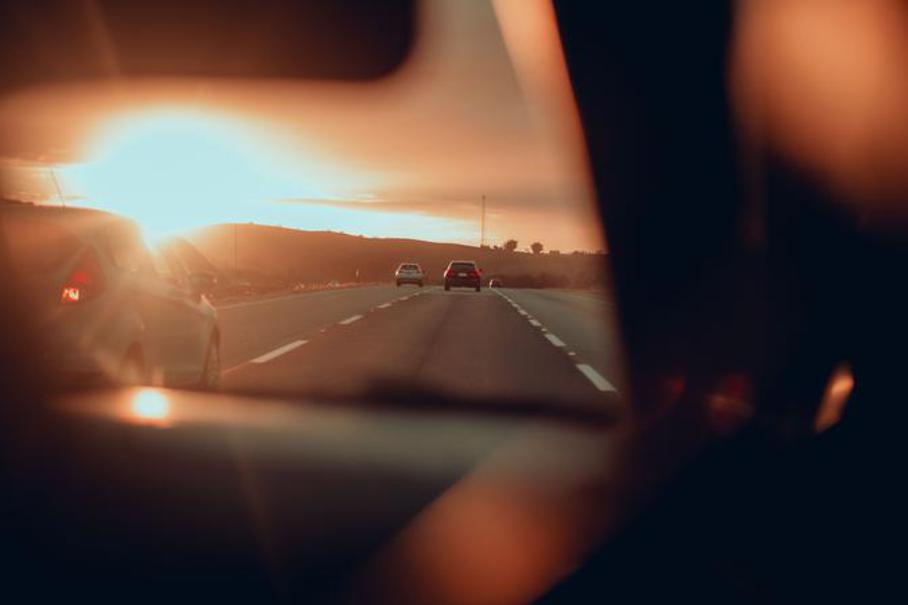
Image by Vijay Richhiya from Pexels
Sushanth Shyamsundar is a Chennai-based poet, fiction writer, and spoken-word performer drawn to places where grief gets strange, tenderness becomes awkward, and ordinary life develops personality. His work moves between poetry, flash fiction, horror, humour, and speculative writing, using dark comedy, surreal images, family memory, queerness, asexuality, and emotional aftermath as raw material. His writing has appeared in journals and anthologies including The Write Launch, Amsterdam Quarterly, Roe River Review, Moonstone Arts Center, and Art on the Trails. In 2026, “WHAT THE FIELD KEPT” won the Art on the Trails Poetry Prize, while his fiction received honorable mentions from Roe River Review. He is the author of The Opposite of You, The Beginning of Me and performs as Rakshasan, a masked persona exploring the distance between the private self and the one willing to be seen.
__________________________________________________________________________________________________________________________________________________________________________

__________________________________________________________________________________________________________________________________________________________________________
© 2026 Iron Oak Literary




Stay Connected to Our Literary Community. Subscribe to Our Substack Roots & Words





Listen: