by Claire Jussel
May 6, 2026
distant water; Milkweed Editions; 96 pages; $18.00.
upon coming home
greet first
not your mother
or the mountain
greet first
the river
So begins Beth Piatote’s debut poetry collection distant water. From this invitation and immersion into moving water, Piatote pulls us into the current of language as it shapes the geography of our senses, histories, and relationships. In the syntax of river, shape of birdsong, and language of Nez Perce, Piatote delivers an intimate and resounding collection that brings the power of language into brilliant light.
Piaote writes in English and her heritage language, Nez Perce, which serves as both a medium and subject of this collection. Across distant water, Piatote speaks to the complications and possibilities of the translation, study, and revitalization of Nez Perce. In footnotes, epigraphs, and the bodies of her poems, Piatote traces the shape of Nez Perce words and parts of speech with linguistic reverence:
I cause my heart out pour out is how to say remember
or perhaps: my heart causes to pour out
it’s hard to translate
causative + heart + pour out
in words
Piatote’s attention to language structure emanates into distant water’s typographic and sonic landscapes. Poems flow and scatter across the full extent of the page, sometimes using bolded, enlarged, or faded type to emphasize certain sounds, articulate the motion of words, and serve as a form of visual interpretation in place of direct translation. Piatote invokes the sounds of the world in the arrival of thunderstorms, recordings of endangered bird calls, and greetings exchanged on a city street. In addition to this sonic invocation, she emphasizes the sounds contained within the printed words on the page through repetition, as in “I cannot say / blood / without the pulse / of a beating / drum // kiké’t / kiké’t / kiké’t / kiké’t.” Piatote’s attention to sound and form echoes a core truth conveyed in distant water: that what when a language is activated–or when it is endangered–it invariably shapes the world and experiences that it is used to articulate.
Piatote’s attention and care for Nez Perce entwines with attention and care for the land and her kin. In her precise and intimate poems, it becomes impossible to engage in language without engaging its history, spirit, and surroundings. Through numerous encounters, connections, and returnings within , the boundaries between the world and the word blur. From a brief moment with an imprint of a deer’s body left in long grass to pointing to scars from the Oregon Trail left behind on the body to a cross-cultural road trip to the underworld, Piatote’s poems crackle with immediacy and connectivity. Numerous encounters in the collection reverberate the intense ache of not-so distant violences and that suppressed and separated Nez Perce and other Indigenous languages from their speakers:
noise and light colonization
change the language
of some animals, including humans–
our elders bear this data
in their lungs
distant water holds both profound grief and also bright moments of reconnection, especially when the language is recognized in its geographic and cultural context. In the poem “Because our roots are in rivers, not Latin,” the reader is invited to “consider this translation: // Not that winter / is the root of hibernation / but that rest / the stillness of fish / is the sign / of deepest cold.”
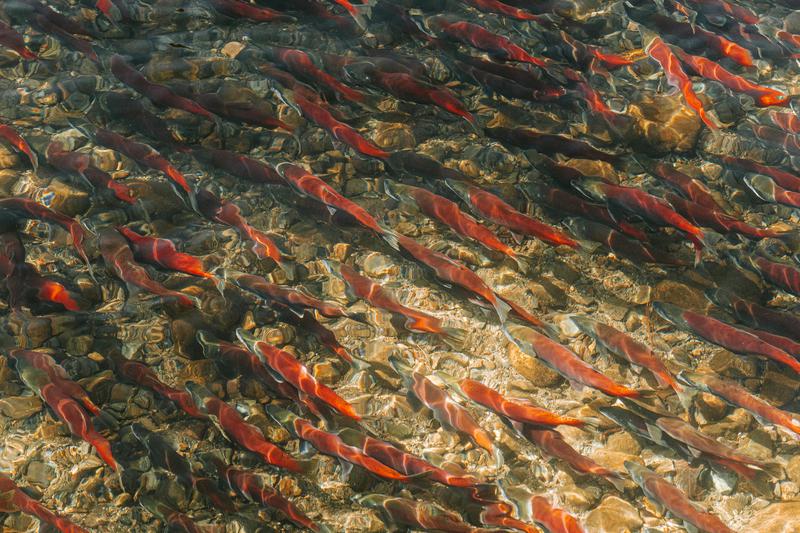
Awe, sorrow, and even humor spring forth together. Near the end of the collection, in an epic poem laced with both levity and reverence, Coyote journeys to the underworld and ultimately breaks down a dam, allowing the river of words to flow back to the people. In the next breath, the next poem, the speaker longs for “Coyote to break the dam at Celio, unbury rock and undo grief that has ached our souls since 1957” when the falls on the Columbia River were drowned. The ancient innovation of the underworld story and present reality of dams along many of Piatote’s home rivers echo back towards the beginning of distant water, where:
nacó’x. hicú·kwece
[salmon knows]
ke ku’ús paláwlimq’as
[the manner of repair]
c’alawí ’eteyé·ku·s hiwséhtse
[if the ocean travels out]
hipa’allá·yikika
 [they go down to the ocean]
 ka: hilá·wcikli·toqsa
[and circle back]
kúnk’u [always]
kúnk’u
[forever]
The past and future, loss and return, merge and loop. The connection and vitality between the flow of the river, the movement of salmon, and the revitalization of the Nez Perce language are more than metaphor; they share a common root.
By both writing about the Nez Perce and the world (in past, present, and future iterations) that it inhabits, Piatote brings the gift of her heritage language to the reader. distant water serves as a moving reminder of the cosmos-shaping power of language, in which each light and weighty part of speech is as deeply connected to the world from which it emerged as it is to the words that surround it on the page.
__________________________________________________________________________________________________________________________________________________________________________
__________________________________________________________________________________________________________________________________________________________________________
__________________________________________________________________________________________________________________________________________________________________________
“Because Our Roots Are In Rivers, Not Latin”: the Vitality of Language in Beth Piatote’s distant water
POETRY REVIEW
Image by Line Knipst from Pexels
Claire Jussel is a poet, writer, and artist from Boise, Idaho. Her work has appeared in or is forthcoming in West Trade Review, Wizards in Space, Split Rock Review, Black Fox Literary Magazine, and SEISMA Magazine. She currently resides in Ames, Iowa where she is pursuing her MFA in Creative Writing & Environment at Iowa State University.
__________________________________________________________________________________________________________________________________________________________________________
© 2025 Iron Oak Editions
__________________________________________________________________________________________________________________________________________________________________________
© 2026 Iron Oak Editions



Stay Connected to Our Literary Community. Subscribe to Our Substack Roots & Words